

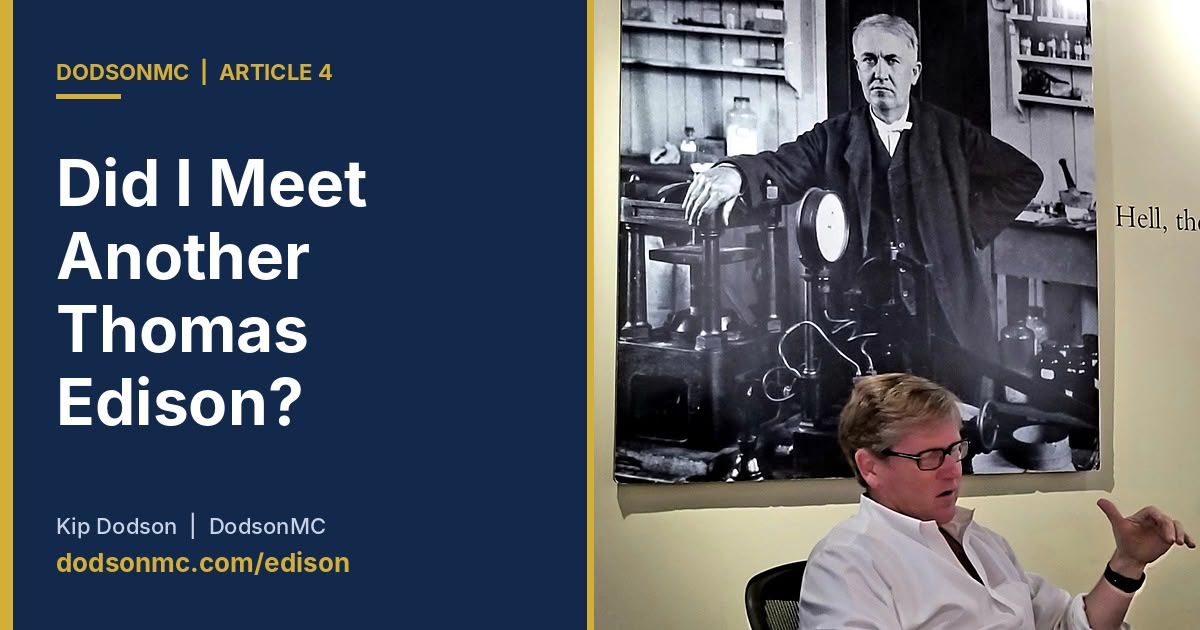
Two inventors, one wall. Charles Howard Cella at Idealab, beneath a portrait of Thomas Edison. Photo: Richard Spitz.
Edison didn't invent the glow - he patented the version that worked. Charles Cella did something similar with LEDs, handing Philips the chair. Next is Applied AI.
By Kip Dodson, Founder, Dodson Management Consulting
Key takeaways
- Edison didn't invent the light bulb - he patented the version that worked. That's what made it his.
- Charles Cella helped Color Kinetics do something similar with LEDs, patenting LED illumination and the networked lighting category.
- Philips bought Color Kinetics in 2007 for about $791 million. LED network lighting was the first chair taken.
- Cella is now the #1 AI patent filer in the U.S. and is doing the same thing for applied AI at Strong Force.
"Hell, there ain't no rules around here! We're trying to accomplish something."
Thomas Edison, on the wall beside his portrait
Ask a room full of operators which figure from history they'd most want to have coffee with, and Thomas Edison makes almost every list. The Wizard of Menlo Park. 1,093 patents. The man who pulled America out of the gaslight era.
None of us get that meeting. Edison has been gone since 1931.
But I think I got something close. His name is Charles Cella, and I have Richard Spitz to thank for it. Richard crossed paths with Charles years ago while running Korn Ferry's global technology practice and recognized his talent. When Richard says you need to meet someone, you make the meeting.
Richard took this photo - Charles mid-thought, sitting directly beneath Edison. A picture is worth a thousand words. The two men in this one are worth more than a thousand patents.
1. Did Edison actually invent the light bulb?
No. And that's the whole point.
Inventors had been experimenting with incandescent lamps for decades before Edison. The patent he was granted on January 27, 1880 - No. 223,898 - was an improvement on electric lamps, not the invention of them. He experimented with thousands of combinations. What Edison patented was the versions that WORKED - reliable, safe, practical. That patent put electric light in American homes.
SO, HERE'S WHAT I'M TELLING YOU: Edison didn't invent the glow. He owned what the glow became.
2. So what did Charles Cella do?
Something similar, more than a century later, with a different glow.
LEDs had been around since the 1960s. They were the red dot on your stereo and the digits on your alarm clock. Nobody treated them as a way to light a room.
As Richard and Charles tell it, George Mueller and Ihor Lys, the founders of a Boston startup called Color Kinetics, saw that LEDs were becoming brighter and more efficient - they believed LEDs would soon move from a display technology to a lighting technology. After a half-dozen patent attorneys told them they couldn't patent their product (because the engineering was similar to displays), they came to Charles.
A bit like Edison, Charles pointed to combinations - in this case, the thousands of combinations enabled between the increasingly powerful LED and other technologies.
Ask Charles, and he'll tell you "a better bulb" was only a small part of the story:
"It's not just a light. It's a light that's digitally native... a light that sits on the same board with a networking chip, a sensor, a processor, and more. That means you could do things with lighting systems that were impossible before."
Charles Howard Cella
With that architecture and Charles's combinatorial methodology, Color Kinetics patented a huge number of variations - the methods, the systems, the applications - describing the many ways digital systems, with LEDs at the heart, would change how we light the world.
That's the real invention. Not a brighter bulb - a whole new category. "We basically helped invent the whole network lighting category," Charles says.
You see what he means every single day. The bulb you dim or switch to a new color from your phone. The lights on your house that turn red and green for Christmas - or your team's colors on game day. The shifting spectrum in the pool or hot tub. The stadium lights that flash and pulse after a touchdown - lights that couldn't flash at all before LEDs, because the old ones took minutes to warm up. The display cases and car interiors that glow in whatever color you pick. Surgical lights that help surgeons and robotic systems see more clearly. NONE of that worked with the old bulbs. That's the category Charles helped Color Kinetics invent.
Before that, the bulb was dumb and the brains lived on the wall - a Lutron dimmer, a theater dimmer rack, or an Allen-Bradley controller from Rockwell switching lighting circuits on a plant floor. I spent 23 years at Rockwell. I know exactly what those panels looked like. Then the light itself became the computer.
Public patent records list Charles as a named co-inventor on Color Kinetics filings alongside founders George Mueller and Ihor Lys. By 2007, the company held 71 issued patents.
3. Who took the first chair?
Philips.
In June 2007, Royal Philips Electronics agreed to acquire Color Kinetics for $34 a share - roughly $791 million in cash. Philips pointed to Color Kinetics' growing licensing income, which tells you competitors were already paying to use what was in that portfolio. Those patents now sit with Signify, the former Philips Lighting.
Walk down the LED aisle at any hardware store. That's the result. A patent portfolio written BEFORE the market existed decided who would lead the category once it did.
SO, HERE'S WHAT I'M TELLING YOU: That's Chair #1 on our board. LED network lighting - decided.
4. Why does this matter right now?
Because it's happening again. This time with AI.
Edison patented the practical light bulb before America was wired. Charles helped Color Kinetics see the opportunity to patent networked LED lighting before anyone was shopping for LED bulbs. In both cases, the first big patent mover shaped the industry everyone else had to build within.
Today Charles is the #1 AI patent filer in the United States - 605 AI patents from 2019 to 2025, according to GreyB Research. His company, Strong Force, doesn't focus on standalone AI. It focuses on the deep interplay between AI and the rest of the economy - the thousands of combinations as AI converges with everything else. Strong Force uses the same combinatorial methodology today, supercharged by years of experience. As co-founding Managing Director for Innovation and IP at Strong Force, he's doing for applied AI what he did for lighting. And he knows which patents matter:
"Most patents cover optional product features or incremental technology advances that can be omitted or designed around. Patents on durable architectures and converged systems are something completely different."
Charles Cella, Strong Force
That's not a prediction. It's a pattern. And you've already watched it play out once - at the hardware store and everywhere the lights are on around you.
THE BOTTOM LINE: No rules. Just something to accomplish.
Most of us will never meet Edison. I got to meet the man who did something a bit similar to what Edison did - with light - and is doing it again with AI. If you lead a company in a category AI is about to reshape, I'm happy to make the introduction.
Reach me at kip@dodsonmc.com or on my cell at 615-717-7616.
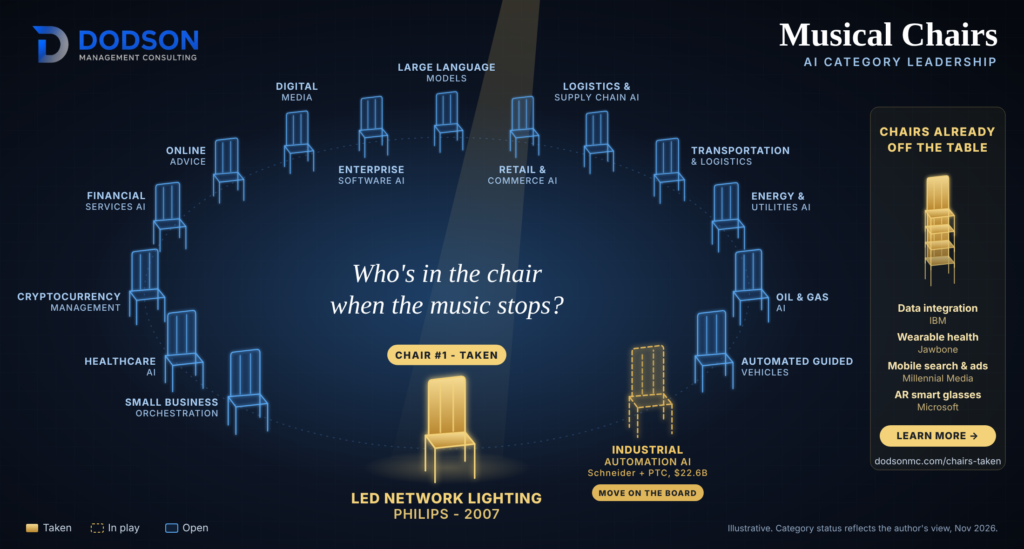
CHAIRS ALREADY TAKEN: See which AI categories are already off the board in Article 5: Chairs Already Taken - dodsonmc.com/chairs-taken
Sources
- National Archives - Edison's lamp patent No. 223,898 (Jan. 27, 1880), an improvement on electric lamps; Edison held 1,093 U.S. patents
- Charles Cella, author's recorded conversation with Charles Cella and Richard Spitz, Oct. 26, 2026; early patent landscape as recounted by Richard Spitz
- Justia and Google Patents - Cella named co-inventor on Color Kinetics filings with Mueller and Lys; patents now assigned to Signify
- LEDs Magazine, June 2007 - Color Kinetics' 71 issued patents and licensing income
- Color Kinetics SEC Form 8-K exhibit, June 2007 - $34 per share, about $791M
- GreyB Research - Top AI patent inventors, 2019-2025
- Strong Force founder quotes, provided to the author for publication, Oct. 2026
This piece reflects Kip Dodson's personal perspective and is not investment or legal advice. Originally published at dodsonmc.com/edison.