

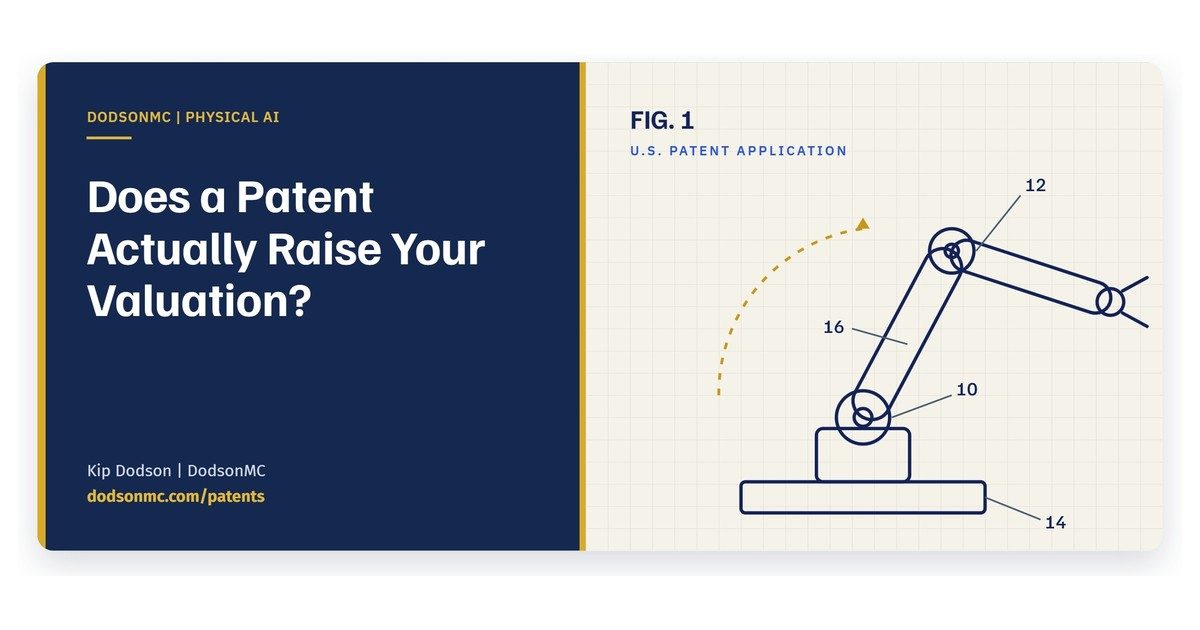
The machine is what everyone sees. The value is in what's protected underneath it.
Founders ask whether patents are worth it before a raise. The best evidence says yes - and for physical AI companies, the gap between filers and non-filers is getting wider.
By Kip Dodson, Founder, Dodson Management Consulting
By the Numbers
Every founder I meet asks some version of the same question. "Do I really need to spend money on patents before I raise?"
It's a fair question. Patents cost real money, they take years, and most investors say they back teams, not paperwork.
SO, HERE'S WHAT I'M TELLING YOU: A patent isn't paperwork. It's the RECEIPT for your innovation - and investors pay more for companies that can show the receipt.
Isn't this just correlation dressed up as proof?
Usually, yes. Most patent studies share one flaw. Better companies file more patents, so of course patent holders look better. That's why I start with the one study that gets around the problem.
Economists Joan Farre-Mensa, Deepak Hegde and Alexander Ljungqvist used a quirk of the US patent system. Applications get assigned to examiners more or less at random, and some examiners approve far more than others. Two startups with similar inventions can get different outcomes based on the luck of the draw. That's about as close to a controlled experiment as the real world gets.
The startups that won that "patent lottery" had 55% higher employment growth and 80% higher sales growth five years later. The authors traced the boost to one thing - the patent made it easier to raise money from VCs, banks and public investors. The study ran in the Journal of Finance in 2020.
SO, HERE'S WHAT I'M TELLING YOU: Same invention. Same market. Different outcome. The patent made the difference.
How much more likely are you to get funded?
In 2023 the European Patent Office and the EU Intellectual Property Office matched startups' IP filings against their funding rounds. Their joint study found a big jump at the early stage - and a real one at exit.
How many times more likely, versus startups with no IP filings
| Early-stage funding | Successful exit (IPO or acquisition) | |
|---|---|---|
| Trade marks only | 4.3x | 2.1x |
| Patents only | 6.4x | 2.4x |
| Patents + trade marks | 10.2x | 3.2x |
Source: EPO and EUIPO, Patents, Trade Marks and Startup Finance, October 2023
Now look at who holds patents at each stage. Only 10% of seed-stage startups had filed for one. At early growth it was 28%. By late stage, 44%. The companies that make it to the later rounds are the ones holding IP.
SO, HERE'S WHAT I'M TELLING YOU: Patents don't just get you in the room. They get you to the EXIT.
Does a patent change the price, or just the odds?
Both. Wharton's David Hsu and Oregon's Rosemarie Ziedonis studied 370 venture-backed semiconductor startups. Patents did two jobs. They protected the product, and they ALSO got founders better terms from investors.
Better odds. Better terms. That's not a legal expense. That's a capital strategy.
Why does this matter more in physical AI?
Because in physical AI, the hardware is what everyone sees - and the value sits somewhere else. A robot arm can be copied. The control software, perception stack and training methods are what make it hard to copy, and they're only defensible if someone filed on them.
I spent 23 years at Rockwell Automation and time as a Disney Imagineer. I've watched great engineering get reverse-engineered in months. The teams that kept their edge were the ones who protected what was underneath the machine.
And the money is moving fast. Robotics and physical AI startups raised $27.6 billion across 1,009 deals in 2025, more than double 2024, according to PitchBook. Bigger checks come with harder diligence.
SO, HERE'S WHAT I'M TELLING YOU: The robot is what investors see. What's underneath is what they PAY for.
So why are fewer people filing?
This is the part that should get your attention. US patent applications fell 9% in 2025 to 393,344, the lowest level since 2019, according to IFI CLAIMS.
Capital is going up. Filings are going down. When fewer of your competitors file, every patent you hold stands out MORE in the diligence room.
What if you're "just" implementing AI?
This is where a lot of companies live right now. They didn't build the model. They take a model from someone else and put it to work - in a warehouse, a clinic, a factory line, a fleet. And you've probably heard the chatter: "You can't patent AI implementations."
That's half true, and the half that's true matters. In April 2025 the Federal Circuit decided Recentive Analytics v. Fox. Its holding: patents that simply apply generic machine learning to a new data environment, with no real improvement to the technology, aren't eligible for protection. The patent owner had admitted it wasn't claiming any improvement to machine learning itself.
So if your whole story is "we pointed an off-the-shelf model at a new industry," the courts have already answered you. That's not an invention. That's a use case.
Now the other half. Five months later, the new USPTO Director, John Squires, used a rarely convened review panel in Ex parte Desjardins to reverse an AI rejection. The panel found the claims patent-eligible because they reflected real improvements in AI technology, and the office made the decision precedential.
"Categorically excluding AI innovations from patent protection in the United States jeopardizes America's leadership in this critical emerging technology."
USPTO Director John Squires
Since then, the office has been friendlier to AI and machine learning inventions than it had been in years. One caution: Desjardins governs the patent office, not the courts - it likely won't carry much weight in litigation. So aim for the bar the court set in Recentive, not the friendlier one at the office.
The line is clear enough to work with. "AI applied to X" is weak. "Here's the specific technical problem we solved to make AI work in X" can be strong. In physical AI, those problems are everywhere - sensor fusion, latency at the edge, safety interlocks, getting a model to hold up on a real factory floor. That's engineering, and engineering can be protected.
Whatever you can't patent, protect another way. Your training data, fine-tuning recipes and deployment playbooks can be trade secrets. Your data rights live in your contracts. Your name lives in a trade mark.
Here's the hard truth for implementation-only shops. Implementation alone is a service, not an asset - and investors price it that way.
SO, HERE'S WHAT I'M TELLING YOU: If your only edge is a subscription to someone else's model, you don't have a moat. You have a VENDOR.
What should you do this quarter?
File on what you've actually built. Tie filings to shipped technology and product milestones, not wish lists.
Pair patents with your brand. The 10.2x number came from patents plus trade marks, not patents alone.
Build a filing rhythm. One patent is a data point. A steady cadence tells investors the innovation keeps coming.
Decide what stays secret. Some know-how should never be published in a patent. Make that call on purpose.
Claim the improvement, not the use case. Work with patent counsel to describe the technical problem you solved, not just the industry you applied AI to.
SO, HERE'S WHAT I'M TELLING YOU: A patent won't make a bad company good. But it makes a good company EASIER to fund, easier to value and easier to buy. Get the receipt.