


The clock is ticking on who wins each category. We'll be tracking who we think the winners are, one category at a time. We've seen this play out before: Charles Cella helped Color Kinetics patent LED for illumination, but the bigger prize was the category. In his words, "We basically helped invent the whole network lighting category" - and Philips bought Color Kinetics in 2007 to own it. Full story in Article 4: Did I Meet Another Thomas Edison? - dodsonmc.com/edison.
The leaders in the business application layer of AI are being decided right now. It's a game of musical chairs - and every deal takes another chair off the floor.
By Kip Dodson, Founder, Dodson Management Consulting
Key takeaways
- The leaders in the business application layer of AI are being decided now, long before the market matures.
- Inventing a technology and owning its value are two different games - Color Kinetics and Philips proved it in LED lighting.
- McKinsey's 2026 survey: 44% of companies are scaling AI, but only about 6% are high performers. That gap is the game board.
- Every acquisition, partnership and customer lock-in takes a chair off the floor. Partnering early is a strategy. Waiting is a bill.
Every technology wave has a moment when the leaders get locked in. You don't get a notification when it happens. You find out later, when you're paying someone else for the right to compete.
That moment is coming for the business application layer of AI. And it is coming FASTER than most operators think.
1. When does a category leader actually get decided?
Not when the market matures. LONG before that.
Category leaders get decided when the foundational positions get claimed - the platforms, the relationships, and the intellectual property. By the time the press calls someone the leader, the decision was made years earlier.
I've watched this from the inside. Twenty-three years at Rockwell Automation taught me that the companies who set the standard early don't just win the market. They write the rules everyone else plays by.
SO, HERE'S WHAT I'M TELLING YOU: If you're waiting for clarity, you're already late.
2. Why doesn't the inventor always win?
Because inventing the technology and owning the value are two different games.
Fast Company ran a sharp piece on this in October. Naomi Haefner of IMD argues that the companies building the AI models may create enormous value - while the businesses that apply it capture the biggest profits. History backs her up. Electricity didn't make the power companies the richest players. It transformed the manufacturers who rebuilt around it. The internet did the same for search, commerce, and software.
Color Kinetics is the same story at a smaller scale. The patent was the invention. The category was the prize. And the category went to the company that bought it.
And the head start is shrinking. Strong Force co-founder Charles Cella:
"AI has compressed development cycles from years to months. Being first to market no longer provides the leader time to build other structural advantages before a competitor reaches parity."
Charles Cella, Strong Force
Read that again. If everyone else can move just as quickly, speed is not a moat. Something else has to be.
SO, HERE'S WHAT I'M TELLING YOU: The moat you think you have is gone. Figure out what replaced it - before your competitor does.
3. Why is the application layer where the game gets decided?
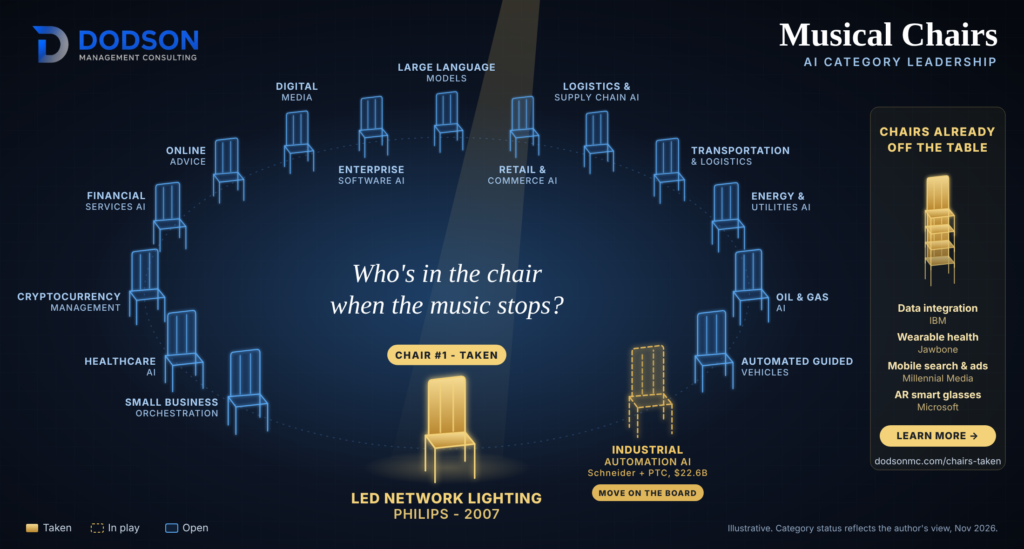
The foundation models get the headlines. But the real value for businesses sits one layer up - in how AI gets applied to real operations, real workflows, and real customers.
The numbers say we're early. McKinsey's 2026 State of AI survey found 44% of organizations now scaling AI across the enterprise - but only about 6% qualify as high performers with significant financial impact. That gap is the game board. The 6% are taking the chairs right now.
Every acquisition, partnership, joint venture and customer lock-in takes a chair off the floor. Schneider Electric's $22.6 billion move for PTC - Article 2 - is one of the biggest moves on the board right now, and that chair could be taken soon. Read more at dodsonmc.com/GS. As Cella puts it, "M&A is starting to drive the Great Rearchitecture."
SO, HERE'S WHAT I'M TELLING YOU: Models get the headlines. The application layer gets the chairs.
4. Who ends up owning the foundational IP?
The Strong Force founders' view is direct: a patent estate of this scale and strategic importance WILL be acquired. And the impact of that ownership won't stop at the acquirer. It will help shape how value gets created and captured across the AI ecosystem as the technology gets embedded in every industry.
"Technology superiority is no guarantee of profitability. Enterprise deployment offers the best path to turn massive infrastructure and model developments profitable, but at the deployment level, the same big question remains: what is the durable moat?"
Richard Spitz, Strong Force
SO, HERE'S WHAT I'M TELLING YOU: The foundational IP in your category will have an owner. Be at the table when that gets decided.
5. What does waiting actually cost you?
There are two ways to deal with foundational IP in your category.
You can partner early - while the chairs are still open and the terms are still built around collaboration.
Or you can wait - and deal with it later, when the chairs are taken and the conversation is about licensing.
SO, HERE'S WHAT I'M TELLING YOU: One of those is a strategy. The other is a bill.
6. So what should an operator do right now?
Start with three honest questions:
- Where does AI touch the core of how your business creates value?
- Who is claiming the foundational positions in that space today?
- Are you at the table - or on the menu?
Marketing is a technology problem. So is market leadership. The operators who treat it that way - with systems, not hope - are the ones still seated when the music stops.
SO, HERE'S WHAT I'M TELLING YOU: Waiting is a decision too. It's just the most expensive one.
THE BOTTOM LINE: The music is still playing.
You don't have to win today. But you do have to decide today whether you're going to compete for a chair or pay the one who's sitting in it.
Reach me at kip@dodsonmc.com or on my cell at 615-717-7616.
CHAIRS ALREADY TAKEN: See which AI categories are already off the board in Article 5: Chairs Already Taken - dodsonmc.com/chairs-taken
Sources
- Naomi Haefner, "Anthropic and OpenAI might be building the future, but someone else may own it," Fast Company, Oct. 28, 2026 - paraphrased
- Strong Force founder quotes (Charles Cella, Richard Spitz), provided to the author for publication, Oct. 2026
- McKinsey & Company, "The State of AI in 2026: On the Road to ROI," Aug. 25, 2026 - 44% scaling AI enterprise-wide; about 6% high performers (at least 5% of EBIT from AI)
- Schneider Electric - PTC, $22.6B: Article 2, dodsonmc.com/GS
- Color Kinetics quote: author's conversation with Charles Cella, Oct. 2026.
Personal perspective, not investment or legal advice. Originally published at dodsonmc.com/clock.