

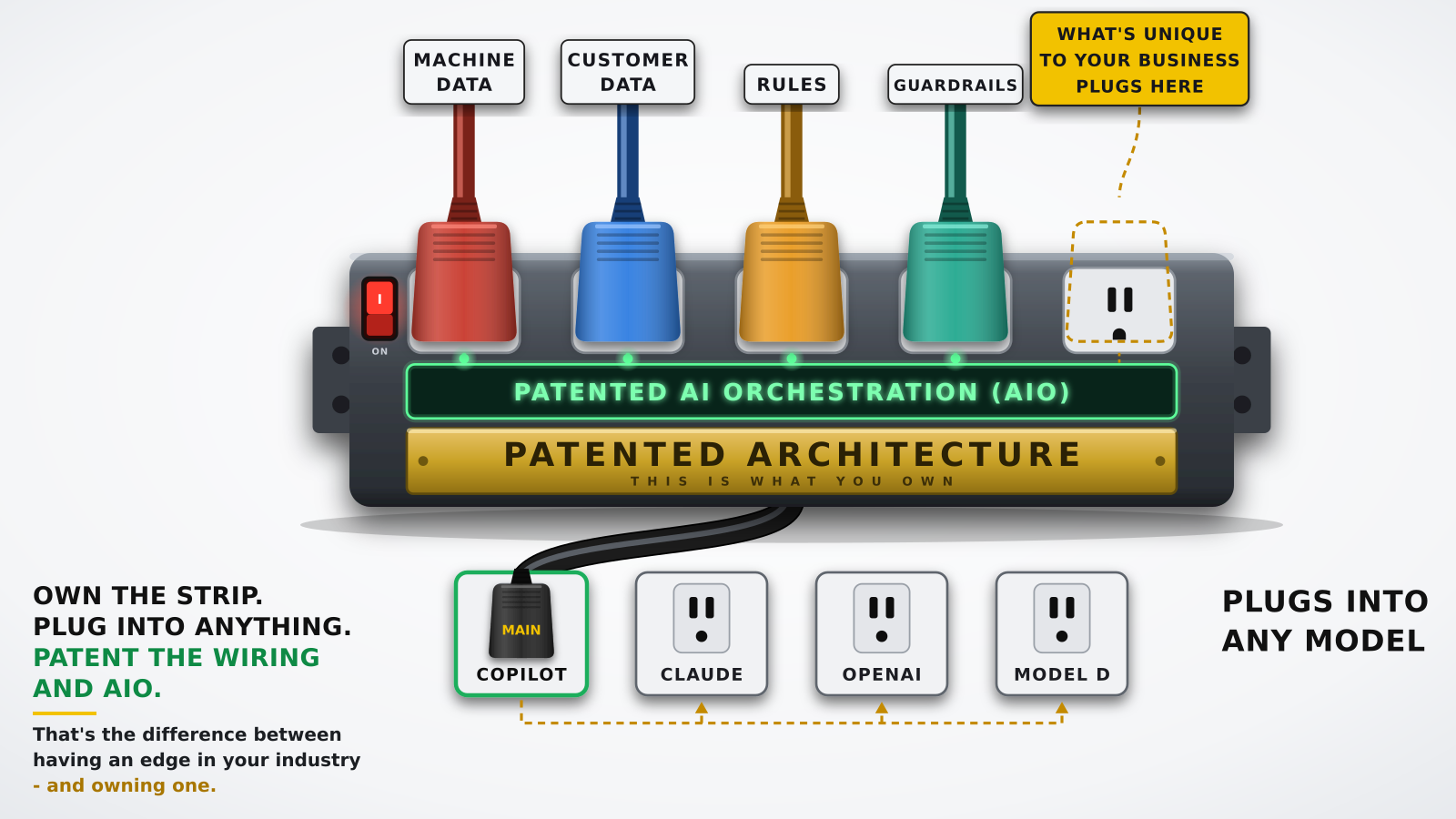
Your data, your rules, your guardrails - orchestrated on an architecture you own. The model is just the outlet.
Microsoft could have kept the door locked. Instead, it threw it wide open.
Over the past few months, Microsoft took Dataverse - the platform that holds the records, relationships and rules that run thousands of businesses - and opened it up to AI agents built by other companies. First Claude and GitHub Copilot. Then Cursor. Then OpenAI and Codex. Microsoft's own description: meeting developers "where they already work."
Read that again. Microsoft is letting AI tools from OTHER companies plug straight into the heart of its customers' businesses.
My colleague Richard Spitz, Strong Force co-founder and managing director, spotted what this implies right away. And once you see it, you can't unsee it.
Why would Microsoft hand the car keys to everyone else?
Because Microsoft has figured out the model isn't the prize.
Richard put it this way: "The harder the models compete, the less any one of them matters to the platform." Whichever AI a customer picks, it has to read from Dataverse and write back to it. The records live there. The rules live there. The guardrails travel with it.
So Microsoft doesn't care which model you choose. It wants every model to come through its layer when it does anything valuable.
Richard's fellow co-founder and managing director, Charles Cella, saw this coming: "An AI model will become an interchangeable component of a larger system that has the assets and workflows that deliver value in any given category."
The model is the visitor. The AI orchestration layer is the house.
And here's the part every business owner needs to hear: what YOU uniquely do with it all - your data, your rules, the way you run your business - is your house. If you don't patent-protect all of that, the AI model absorbs it and makes it available to others. The visitor strips the house of the family jewels and the furniture.
What does a power strip have to do with AI?
Look at the image at the top. Everybody knows how a power strip works.
- The plugs going in are YOURS. Your machine data. Your customer data. Your operating rules. Your guardrails. That open socket is whatever makes your business unique.
- The glowing band is AI orchestration (AIO). It's what enables what is plugged in to work in learning loops, instead of sitting in separate silos.
- The strip itself is the architecture. It's the thing everything runs through.
- The main plug goes into ANY model. Copilot today. Claude tomorrow. OpenAI next quarter. Whatever comes after that.
Swap the outlet and the lights stay on. Lose the strip and nothing works, no matter how good the outlet is.
Here's the kicker: machine data and customer data almost never sit in the same system. The company that connects them - and owns how they're connected - gains a new performance advantage. The one that creates a moat around that performance advantage wins.
SO, HERE'S WHAT I'M TELLING YOU: Plugging in is easy. Owning the strip is the whole game.
So does Microsoft own the strip?
No - and this is the catch nobody's talking about.
Dataverse is Microsoft's house. The records inside may be yours, but the platform, the terms and the roadmap are Microsoft's. Microsoft opened the door to every model. It did NOT hand you the deed to the building.
Dataverse is a fine place to keep your records. It is not your architecture. It doesn't know how YOUR business turns machine data and customer data into a decision - and it doesn't own that either.
That's the part you can own. Richard calls it derived operational intelligence: your workflow logic, your agent memory, your feedback loops. The way your business actually thinks.
How does a business own its own strip?
- Map what's uniquely yours. Which data do you combine that your competitors don't? Which rules and judgment calls make you better?
- Build the orchestration around YOUR workflows, not a vendor's. That way the main plug can move from Copilot to Claude to whatever's next without losing a thing.
- Patent how it's built. Protect the system-level architecture of how AI is applied to your workflows - before a competitor, or a platform, gets there first.
- Work with people who've done it. That's what Strong Force's Design and Engagement work is built for: partnering with a company that wants to lead its category and building patent positions on how AI is applied to its workflows.
Can't a competitor just design around a patent? Not a patent that covers the architecture. As Charles Cella puts it: "Most patents cover optional product features or incremental technology advances that can be omitted or designed around. Patents on market architectures are something completely different. These are among the most durable moats a business can have."
Microsoft owns Dataverse. You should own the architecture of your market.
Isn't running your own AI the same as owning it?
No. And this is the part most companies miss.
Stephen Messer laid out the stakes in Fortune: Rent the model. Own the harness. Own the network. The "harness" is the controller that applies your configuration, governance and integration rules to a system where AI models are just components.
Richard took it one step further. If your AI vendor runs the harness, your know-how migrates onto their platform. And even if you run it yourself, controlling how it operates is not the same as owning the underlying architecture.
That distinction is Strong Force's entire strategy: patents covering the market architectures through which AI is orchestrated, governed, integrated and deployed. Richard goes deeper on why agentic AI shifts the value to deployment architecture in Beyond Royalties.
SO, HERE'S WHAT I'M TELLING YOU: Running it is rent. Owning it is equity.
Want to see it for yourself?
Microsoft showed exactly how this works at its Build 2026 conference: Microsoft Dataverse plugin: unleashing coding agents on the enterprise. Watch how an AI agent - from any vendor - works inside the business's records and rules, with the guardrails built in.
Then ask yourself one question while you watch: who owns the layer that agent is working inside?
How did I figure this out?
I've watched this movie before. At Disney, the rides changed but the systems behind the magic stayed. Then I spent 23 years at Rockwell Automation, where the machines on the plant floor changed every few years - but the control layer that ran the plant stayed put. That's where the value lived. Now it's happening with AI - just ten times faster.
The companies that own that strip will collect from every model that plugs into it. Everybody else is just paying the electric bill.
Own the strip. Plug into anything. Patent the wiring and AIO.
So here's what I'm telling you
Stop asking which AI will win. Microsoft just answered that question for you - it let ALL of them in because it believes none of them are going to win.
The models are great. In fact, they all became so great so fast that they're becoming interchangeable. The value is moving to the strip they plug into: your data, your rules, your guardrails, and, most important, the AI orchestration that links them together, creating the opportunity for unique learning loops.
So ask the questions that actually matter. Who controls the main plug? Who owns the architecture? And who owns the rights to how it's built?
Those answers are being decided right now, category by category. The clock is ALREADY running.
Own the strip. Plug into anything. Patent-protect your inventions.
Patent-protect your unique approach.
Kip Dodson Dodson Management Consulting
More in this series
Sources
- Richard Spitz, Strong Force - LinkedIn post on Microsoft Dataverse (#AI_Irony) and "own the harness" post, November 2026
- Richard Spitz - Beyond Royalties
- Microsoft Power Platform Blog - Dataverse Is Your Agent Data Platform: Here's What's New in July 2026
- Microsoft Power Platform Blog - Dataverse Plugin for Coding Agents: OpenAI and Codex Marketplace Expansion
- Stephen Messer, Fortune - Rent the model. Own the harness. Own the network.
- Microsoft Build 2026 - Microsoft Dataverse plugin: unleashing coding agents on the enterprise
- Charles Howard Cella, Strong Force co-founder and managing director - direct quotes from conversations with Kip Dodson, October 2026