

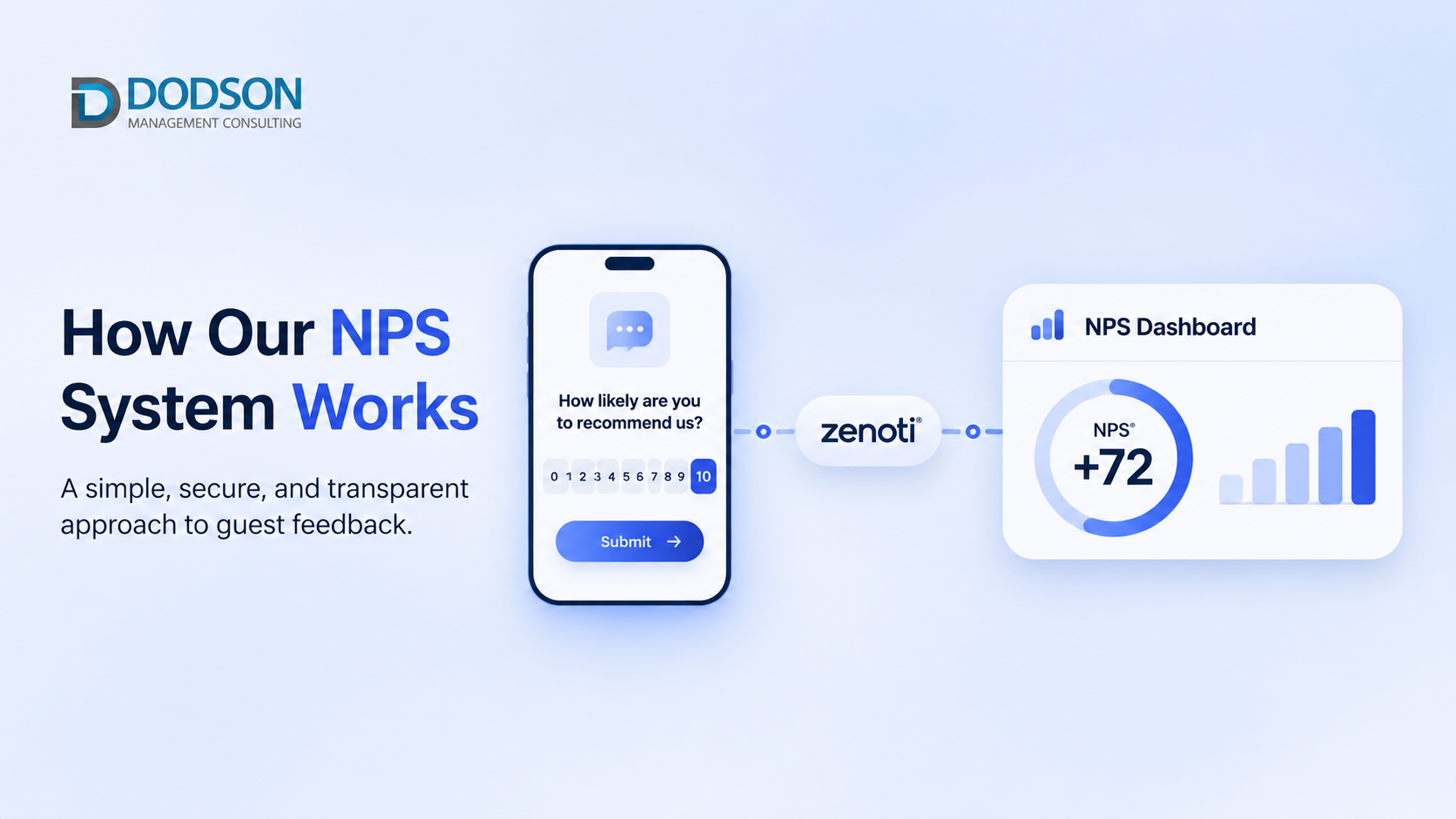
How we connected Net Promoter Score to Zenoti, automated client feedback, and built a more transparent way to measure the guest experience.
Kip Dodson | Owner, A Moment’s Peace Salon & Day Spa
Every salon owner wants great reviews.
But here’s my question.
How do you know your client satisfaction numbers are telling the truth?
Are you hearing from every guest or only the happy ones? Are the scores connected to actual visits? And when someone reports a problem, does your team have the information needed to address it?
At A Moment’s Peace Salon & Day Spa in Franklin, Tennessee, we’ve measured Net Promoter Score (NPS) since July 2019.
I explained why I started in my earlier SALON TODAY article on Net Promoter Score.
Our latest dashboard shows 17,759 completed guest surveys and an all-time NPS of +90, which our system classifies as Elite.
I’m proud of those results. But what matters even more to me is knowing how the scores were collected and what we’re learning from them.
When we transitioned to Zenoti in 2026, we built a custom NPS system to preserve our historical feedback and automate the collection process.
Here’s how it works.
One Visit. One Survey.
Zenoti manages our appointments and transactions.
Every few minutes, our NPS system checks for invoices that have been closed and paid. Each eligible invoice generates one survey.
Why does this matter?
A client might receive a haircut, color service, and another treatment during one visit. That shouldn’t result in three survey requests.
One visit
- Haircut
- Color service
- Another treatment
One survey
From the closed, paid invoice
- Automated text message
- Zenoti thank-you message
A score and, if they choose, a written comment
We’re measuring the guest’s overall experience, not the number of services purchased.
After checkout, the guest receives an automated text message with a private feedback link. The same question is also available through Zenoti’s thank-you message.
Both methods connect the response to the appropriate guest and invoice.
The guest provides a score and, if they choose, a written comment.
The process is simple for the client and automatic for our team.
How We Calculate NPS
Net Promoter Score measures how likely a client is to recommend a business.
Responses fall into three categories:
Promoters, passives, and detractors come from the Net Promoter Score methodology.
Guests most likely to recommend us.
Guests who are not classified as promoters or detractors.
Guests whose feedback deserves closer attention.
NPS is calculated by subtracting the percentage of detractors from the percentage of promoters.
For example, 80% promoters minus 10% detractors produces an NPS of +70.
The score ranges from -100 to +100.
At A Moment’s Peace, our all-time NPS currently stands at +90 across 17,759 completed guest surveys.
We also preserved historical NPS responses from our previous salon software when transitioning to Zenoti.
Those historical scores remain part of our cumulative results, allowing us to maintain a consistent view of client feedback collected since 2019.
I wrote about our approach to measuring client satisfaction as that history took shape.
What Our Team Sees Versus What Guests See
Our internal dashboard shows each response, including the score, guest information, associated visit, and written feedback.
This gives management the information needed to investigate concerns and follow up with guests.
The public website works differently.
It displays recent guest comments through a carousel and shows a live count of scored responses.
Prospective guests can also read A Moment’s Peace client reviews.
These displays use the same underlying NPS records, but they don’t expose the private information our team uses internally.
The website loads a small script to request public feedback and the current count. It doesn’t connect directly to our database.
Guest phone numbers, email addresses, and invoice identifiers stay out of the public display.
We also distinguish between NPS responses and third-party reviews.
For example, our comment carousel represents NPS scores of 9 or 10 using five filled stars. That is a visual representation of first-party feedback, not a separate five-star Google review.
Accuracy matters, especially when publishing customer satisfaction information.
What Makes This System Valuable?
The technology serves one purpose: helping us listen to our clients and improve.
For me, that begins with measuring customer loyalty.
Here’s the process:
- 1Completed visit
- 2Automated survey
- 3Guest response
- 4NPS calculation
- 5Management follow-up
- 6Public feedback display
Each step has a purpose.
Zenoti confirms the completed transaction.
Our survey system collects the feedback.
The dashboard helps our team understand and respond.
And the website gives prospective guests a view of the experiences our clients have reported.
Most importantly, the system doesn’t depend on someone manually choosing which guests should receive a survey.
The collection process follows eligible completed invoices, while the NPS calculation includes promoters, passives, and detractors.
A low score isn’t something I want hidden.
It’s something I want our team to understand.
The point of that follow-up is using NPS to improve client loyalty.
The Standard I Believe Every Salon Should Follow
Whether you’re using Zenoti or another salon management platform, I encourage you to ask a few questions about your customer feedback system.
Are surveys connected to completed visits? Are all score categories included? Does management have enough information to address concerns? And is private guest information kept separate from public feedback?
These details determine whether your NPS is a useful management measurement or another number on a dashboard.
I have written about why NPS matters beyond client retention.
At A Moment’s Peace, our +90 NPS represents feedback from 17,759 completed guest surveys and years of work by our team.
But I don’t believe the number alone tells the complete story.
We need to understand what our clients are telling us and use the information to improve.
A great NPS score is worth celebrating. A transparent system behind the score is what gives it meaning.
That’s why we built ours this way.
About the Author
Kip Dodson is the owner of A Moment’s Peace Salon & Day Spa in Franklin, Tennessee, and founder of Dodson Management Consulting and Digital Basics Score. His work focuses on measurable business performance, client loyalty, and technology that helps owners make informed decisions.